

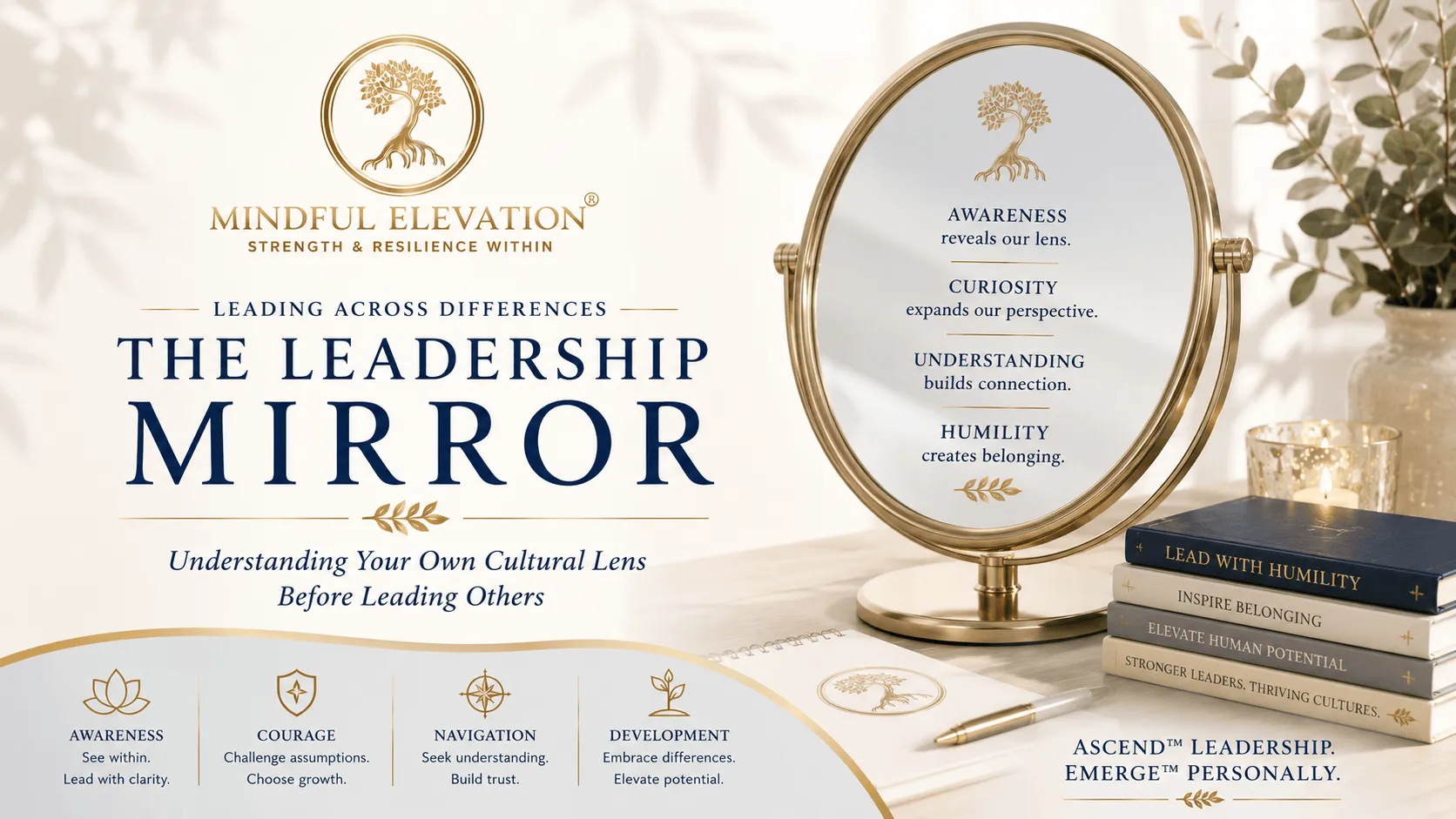
Understanding Your Own Cultural Lens Before Leading Others
"The greatest barrier to understanding others is often the assumption that we already do." — Dr. Jacqueline Nelms
As leaders, we spend much of our careers learning to understand markets, financial performance, operational efficiency, strategic planning, and organizational change. We invest countless hours refining our ability to solve complex problems and make informed decisions. Yet one of the most influential forces shaping every leadership decision often goes unnoticed.
- It is not a process.
- It is not a policy.
- It is not even another person.
- It is us.
Every leader views the world through an invisible lens, a collection of beliefs, experiences, values, assumptions, and perspectives accumulated over a lifetime. This lens influences how we interpret situations, evaluate performance, respond to conflict, build trust, and connect with the people we lead. Because it is so deeply embedded within us, we rarely recognize its existence.
- We simply believe we are seeing reality as it is.
- In truth, we are seeing reality as we have learned to interpret it.
- This is where culturally competent leadership begins.
- Not with learning about someone else's culture.
- With becoming aware of our own.
Culture Is Far More Than Demographics
When the phrase "cultural competence" is mentioned, many people immediately think of ethnicity, nationality, or language. While these dimensions certainly matter, culture is far broader than demographic categories.
Culture encompasses the values we inherited from our families, the communities that shaped us, our educational experiences, professions, faith traditions, socioeconomic circumstances, military service, generational influences, organizational environments, and even the unwritten rules we have internalized throughout our lives.
Consider healthcare.
A physician, nurse, financial counselor, environmental services technician, and executive may all work within the same hospital, yet each has been shaped by a distinct professional culture. They communicate differently, prioritize different aspects of patient care, and often approach problem-solving from unique perspectives. None are inherently right or wrong; each reflects the culture in which they were developed. The same is true in every organization. When leaders assume that everyone interprets situations through the same lens they do, misunderstanding becomes almost inevitable. The challenge is not that people are different. The challenge is believing they are not.
The Brain Prefers Familiarity
Behavioral science provides insight into why this occurs. Our brains are designed to process extraordinary amounts of information every day. To conserve energy, they rely on cognitive shortcuts, mental frameworks known as schemas, that help us quickly interpret the world around us. These shortcuts are remarkably efficient. They also create blind spots.
Without conscious awareness, we naturally gravitate toward people who communicate like us, solve problems like us, and validate our existing beliefs. Familiarity feels comfortable because the brain associates it with safety and predictability. This tendency is not evidence of poor character. It is evidence of being human. The danger arises when leaders mistake familiarity for competence or similarity for potential.
Research in organizational behavior consistently demonstrates that unconscious assumptions influence hiring decisions, performance evaluations, promotion opportunities, and team dynamics. Often, these influences occur without any deliberate intent. Leaders may sincerely value fairness while unknowingly rewarding those whose communication style, personality, or worldview most closely resembles their own. Intent and impact, however, are not always the same. Effective leadership requires us to examine both.
Looking Into the Leadership Mirror
Within the ASCEND™ Leadership Method, awareness is not simply the first step of leadership development; it is the foundation upon which every other leadership behavior is built.
- Without awareness, courage becomes reactive.
- Without awareness, empathy becomes selective.
- Without awareness, decision-making is limited by assumptions we do not realize we hold.
Awareness invites leaders to pause before evaluating. To become curious before becoming certain. To recognize that every interaction is shaped by both the person in front of us and our own experiences. This kind of self-examination requires courage. Not the courage associated with making difficult business decisions or navigating organizational change. The quieter courage of asking ourselves difficult questions.
- Why did I react that way?
- What assumptions am I making?
- What experiences have shaped my perspective?
- Could another interpretation be equally valid?
These questions do not weaken leadership. They strengthen it.
Cultural Humility Is a Lifelong Practice
Leadership maturity is often measured by expertise. Yet some of the most effective leaders possess another quality that receives far less attention: cultural humility. Unlike competence, which can imply mastery, humility recognizes that understanding people is an ongoing process rather than a destination. No leader will ever know every experience, every perspective, or every cultural influence represented within their organization. Nor should they expect to.
Instead, exceptional leaders remain curious.
- They ask thoughtful questions.
- They listen with genuine intent to understand rather than simply to respond.
- They recognize that every conversation offers an opportunity to expand their perspective.
Within the EMERGE™ Method, development is not merely the acquisition of knowledge. It is the continuous expansion of perspective. As leaders encounter people whose experiences differ from their own, they are given an opportunity to grow not only in competence but also in wisdom. Inclusive growth begins long before organizational initiatives. It begins within the leader.
Leadership Begins Before Anyone Else Enters the Room
Many organizations invest significant resources in developing communication skills, emotional intelligence, conflict resolution, and team effectiveness. These are all valuable leadership competencies. Yet each depends upon a deeper capacity: the willingness to understand ourselves before attempting to understand others.
- Leadership is never culturally neutral.
- Every decision communicates values.
- Every interaction shapes belonging.
- Every conversation either reinforces assumptions or expands understanding.
The leaders who cultivate resilient, high-performing organizations are not those who have eliminated every blind spot. Rather, they are those who acknowledge that blind spots exist and intentionally seek to uncover them. Their greatest strength is not certainty. It is curiosity.
Leadership Lens
Inclusive leadership is not about having all the answers or being an expert in every culture in your organization. It is about leading with enough humility to recognize that your perspective is only one among many. The most trusted leaders create environments where people feel seen before they feel evaluated, heard before they are judged, and respected even when perspectives differ. That is where belonging begins, and belonging is where resilience grows.
Executive Reflection
Before we can understand the people we lead, we must first understand the lens through which we see them. This week, resist the temptation to assume. Instead, choose curiosity over certainty. Ask one additional question. Listen a little longer. Seek to understand before offering your own perspective. Leadership is not diminished by humility. It is elevated by it.
Dr. Jacqueline Nelms
Founder, Mindful Elevation / Behavioral Scientist / Executive Leadership & Resilience Strategist