
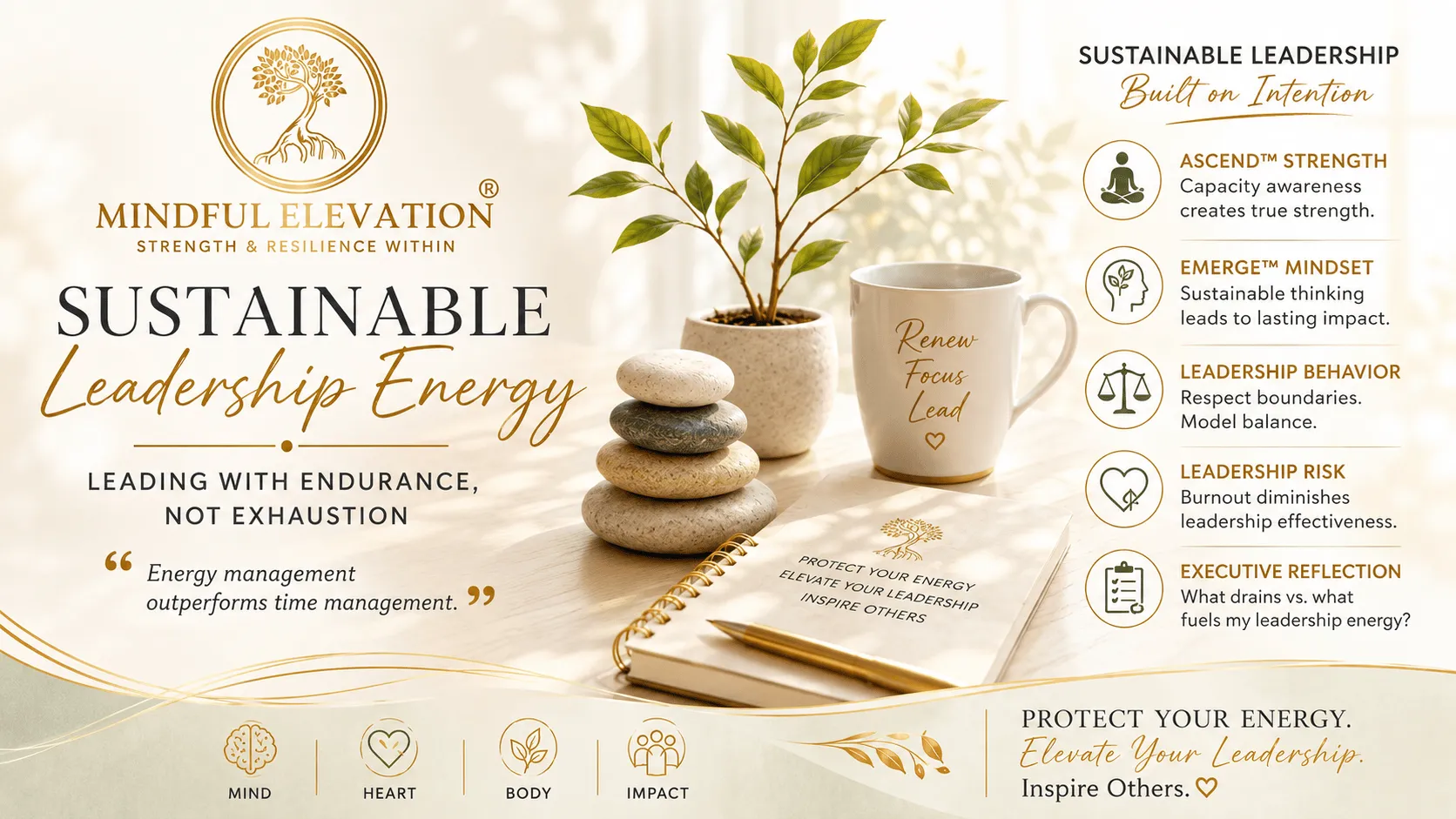
"The most effective leaders are not those who work the hardest; they are those who lead most sustainably."
Leadership today demands more than technical expertise and strategic vision. It requires sustained mental clarity, emotional resilience, and the capacity to navigate constant change while inspiring others to do the same. Yet many leaders unknowingly sacrifice the very resource that makes exceptional leadership possible: their energy.
For decades, leadership development has emphasized time management as the key to productivity. While managing time remains important, research increasingly demonstrates that energy management consistently outperforms time management. Time is finite and cannot be expanded. Energy, however, can be intentionally cultivated, protected, renewed, and strategically invested. High-performing leaders understand that their greatest asset is not the number of hours they work; it is the quality of energy they bring to every conversation, decision, challenge, and opportunity.
Why This Matters
Every day, leaders make hundreds of decisions, solve complex problems, navigate interpersonal dynamics, and provide direction during uncertainty. Each responsibility draws from four interconnected sources of energy:
- Physical energy that supports stamina and focus.
- Mental energy required for critical thinking and sound decision-making.
- Emotional energy necessary to build trust, regulate reactions, and inspire others.
- Relational energy that strengthens collaboration, influence, and organizational culture.
Unlike time, these energy reserves fluctuate throughout the day. They can either be depleted by chronic stress and constant demands or replenished through intentional leadership practices. Many executives mistakenly believe that productivity means doing more. Sustainable leadership teaches a different lesson: productivity is about maximizing the impact of the energy we invest, not simply increasing the number of hours we work. When leaders manage their energy well, they think more clearly, communicate more effectively, solve problems more creatively, and lead with greater consistency.
Leadership Risk: Burnout Diminishes Leadership Effectiveness
Burnout has become one of the greatest threats facing today's leaders. It rarely occurs because of one exceptionally difficult week. Instead, burnout develops gradually through prolonged stress, relentless demands, and the absence of meaningful recovery.
Leaders often dismiss the early warning signs:
- Constant mental fatigue
- Reduced patience
- Decision fatigue
- Emotional exhaustion
- Difficulty concentrating
- Loss of creativity
- Feeling perpetually "behind"
Over time, these symptoms begin to influence leadership behaviors. Conversations become transactional rather than relational. Strategic thinking gives way to constant firefighting. Innovation decreases while frustration increases.
Neuroscience helps explain why this occurs. Chronic stress elevates cortisol levels, reducing the effectiveness of the prefrontal cortex, the brain region responsible for executive functioning, emotional regulation, strategic thinking, judgment, and complex decision-making. At the same time, the brain becomes more reactive, making it increasingly difficult to remain calm under pressure or to navigate conflict thoughtfully. Simply put, exhausted leaders are less capable of demonstrating the very leadership behaviors their organizations need most. Burnout is therefore not simply a personal wellness issue; instead, it is an organizational leadership issue.
ASCEND™ Leadership Focus: Strength Through Capacity Awareness
Within the ASCEND™ Framework, sustainable leadership is grounded in strength. Strength is often mistaken for the ability to endure endless pressure or shoulder every responsibility alone. In reality, authentic leadership strength begins with awareness of capacity. Capacity awareness is the discipline of recognizing where your energy is being invested, understanding your limits, and making intentional decisions about where your leadership creates the greatest value.
Strong leaders regularly pause to ask themselves:
- Which responsibilities require my unique expertise?
- Where am I creating value versus simply staying busy?
- What responsibilities can be delegated to develop others?
- Which commitments no longer align with our strategic priorities?
- What habits are quietly draining my leadership capacity?
Recognizing personal capacity is not a weakness. It is an act of wisdom. The strongest leaders understand that every "yes" requires an investment of finite energy. Saying "yes" indiscriminately often means saying "no" to the work that matters most. Capacity awareness allows leaders to protect what is essential while empowering others to grow.
EMERGE™ Personal Growth Focus: Sustainable Thinking
The EMERGE™ Framework reminds us that lasting leadership begins with a sustainable mindset. Many accomplished leaders unknowingly operate from beliefs that reward exhaustion rather than excellence:
- "If I don't do it myself, it won't get done correctly."
- "The last one to leave is the most committed."
- "Rest is something I'll earn later."
- "Being constantly busy proves my value."
While these beliefs may produce short-term results, they often create long-term leadership fatigue. Sustainable thinking replaces these assumptions with healthier and more effective leadership principles:
- Rest improves performance.
- Boundaries increase effectiveness.
- Delegation develops future leaders.
- Recovery strengthens resilience.
- Consistency creates lasting excellence.
- Sustainable leadership produces sustainable organizations.
Leadership is not measured by how much energy we expend. It is measured by the positive impact we consistently create.
Leadership Behavior: Model the Balance You Want Others to Live
One of the most influential leadership behaviors is modeling healthy boundaries. Employees pay close attention to what leaders normalize. When leaders routinely respond to emails late into the evening, skip vacations, cancel personal commitments, or proudly describe working excessive hours, they unintentionally communicate that burnout is the expectation rather than the exception. Conversely, leaders who model healthy behaviors permit others to do the same.
This includes:
- Protecting uninterrupted time for strategic thinking.
- Delegating meaningful work that develops others.
- Scheduling recovery after periods of sustained intensity.
- Taking breaks throughout the workday.
- Respecting personal boundaries for themselves and their teams.
- Encouraging flexibility when appropriate.
- Celebrating effectiveness rather than busyness.
These behaviors are not signs of reduced commitment. They are indicators of mature, sustainable leadership. Healthy leaders build healthy cultures.
The Ripple Effect of Leadership Energy
Leadership energy is contagious. Research on emotional contagion consistently demonstrates that leaders' attitudes, emotions, and behaviors spread throughout teams. Calm leaders foster confidence. Overwhelmed leaders often create anxiety. Energized leaders inspire engagement.
- The energy leaders bring into meetings influences collaboration.
- The energy leaders bring into difficult conversations influences trust.
- The energy leaders bring into organizational change influences resilience.
This is why sustainable leadership is not solely about personal wellbeing. It directly impacts employee engagement, psychological safety, retention, innovation, and organizational performance. Organizations rarely outperform the energy of their leaders. When leaders intentionally protect their own capacity, they create environments where people are better equipped to perform at their highest level.
Executive Reflection
Great leadership begins with self-awareness. Consider the following questions this month:
- What consistently drains my leadership energy?
- What activities consistently renew and strengthen my capacity?
- Where have I confused busyness with effectiveness?
- Which commitments no longer serve my highest leadership purpose?
- What boundary would allow me to lead more intentionally?
- How am I modeling sustainable leadership for my team?
- What small change could create greater energy and effectiveness over the next 30 days?
Awareness is the first step toward intentional change.
Leadership Challenge
This month, identify one leadership habit that consistently depletes your energy and replace it with one intentional practice that strengthens your capacity. Small changes repeated consistently produce extraordinary leadership outcomes. Whether that means protecting time for strategic thinking, delegating more effectively, taking intentional recovery breaks, or simply being fully present in your conversations, choose one behavior that supports sustainable excellence. Leadership is not about giving everything away until nothing remains. It is about investing yourself wisely so that you can continue making a meaningful difference tomorrow, next month, and for years to come.
Final Thought
The strongest leaders are not the ones who never become tired. They are the ones who recognize when renewal is necessary and have the wisdom to protect the energy that allows them to lead with clarity, compassion, courage, and purpose. Time is limited. Energy is renewable. How we manage that energy ultimately determines the quality, consistency, and legacy of our leadership.
At Mindful Elevation, we believe sustainable leadership is not about slowing down. It is about leading with greater intention, resilience, and endurance. Because leadership is not measured by how long you can keep running. It is measured by how many others you help rise along the journey.
Dr. Jacqueline Nelms
Founder, Mindful Elevation / Behavioral Scientist / Executive Leadership & Resilience Strategist